














Armillaria species have a wide host range. In South Africa, Armillaria root rot has been recorded on many hosts including commercially-grown forest species such as Acacia mearnsii, Eucalyptus species and Pinus species. It also occurs on fruit trees such as apples, peaches and citrus and on many indigenous tree species. When indigenous forest is cleared for afforestation, the fungus colonizes stumps, which serve as an inoculum base for the pathogen from which it can then infect plantation species.
For many years, Armillaria root rot has been ascribed to the pathogen Armillaria mellea. Recent research has shown that A. mellea is an 'aggregate' species including many discrete biological entities. The species most commonly occurring in forest plantations in South Africa is A. fuscipes (Coetzee et al., 2000).
Trees in plantations with Armillaria root rot are usually found in distinct infection centres radiating out from a single infected tree. Infection centres develop owing to the capacity of the pathogen to move from tree to tree by root contacts. Dying trees are, therefore, usually found at the periphery of the infection centres. Armillaria species can also be opportunistic and infect trees dying of other causes. In this case, infected trees are usually scattered in plantations.
Trees dying of Armillaria root rot usually have yellow (chlorotic) needles and leaves. This symptom is most evident at the end of the dry season. A flush crop of cones is often produced on dying conifers. In addition, resin or gum is usually found exuding from roots and root collars of infected trees. On eucalypts and A. mearnsii the bark at the bases of infected trees often cracks and splits open.
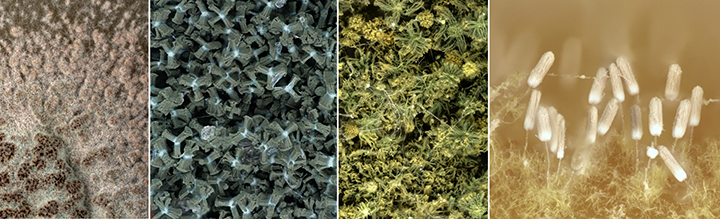
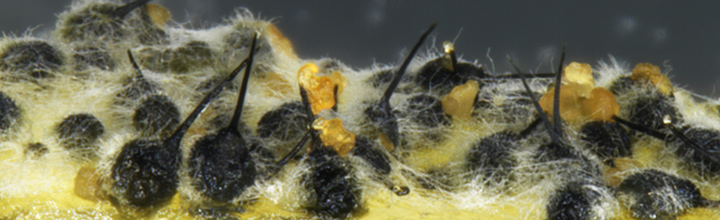
Armillaria root rot is commonly recognised by characteristic signs of the fungus. These include a thick mat of white mycelium under the bark of roots and root collars of dead and dying trees. White "fans' of mycelium may also be present. Other signs of the disease can be the presence of black "shoe-lace-like" rhizomorphs and the production of sporophores (mushrooms) near or on dying trees. Rhizomorphs (fungus roots) are structures that facilitate the movement of the fungus through the soil and from tree to tree. These are not commonly seen in South Africa. Sporophores usually have honey-coloured caps and white gills and are produced in groups at the base of dying trees. They usually occur in spring and are short-lived and thus seldom seen.
|
Disease name: |
Armillaria root rot |
|
|
Causal agents: |
Armillaria fuscipes | |
| Trees affected: |
Acacia mearnsii Eucalypts Pinus spp. Also native trees such as Podocarpus spp. |
|
|
Tree part |
Roots and root collar | |
| Impact: |
Tree death |
|
|
Symptoms: |
Wilting and death of trees, cracking of bark and exudation of resin/gum at bases of trees. White mycelial fan between bark and wood |