











Sap-sucking insects have characteristic piercing-sucking mouthparts that enable them to effectively extract the liquid contents of plants (or animals). In South Africa, the main sap-sucking insects, which are pests on forestry hosts are the aphids, the wattle mirid and the bronze bug. Infestations by these insects can result in damage ranging from leaf-drop, stunted growth, malformation of branches, and in severe cases death of trees. These insects also have a short life-cycle which enables a rapid increase in their population over a short period of time.
Sap-suckers on pine
The two main aphid species in South Africa that are pests of forestry trees are the black pine aphid (Cinara cronartii) (Kfir and Kirsten 1991) and the pine woolly aphid (Pineus boerneri). Both these species infest Pinus, and both have been accidentally introduced from the northern hemisphere. The adults are very small, with the black pine aphid being about 4 mm long and the pine woolly aphid about 1 mm long. The black pine aphid can be recognized by the black appearance of trees that are heavily infested. This results from the sooty mould that grows on the honeydew excreted by this aphid. The pine woolly aphid can be recognized by a white woolly wax that it excretes around itself. Infestations of the pine woolly aphid are very sporadic and seldom severe. Infestations of the black pine aphid have been very severe in the past, but this insect is currently under good biological control. Another less serious aphid pest that also infests Pinus is the pine needle aphid (Eulachnus rileyi).
Sap-suckers on wattle
The wattle mired (Lygidolon laevigatum) is a serious pest of A. mearnsii. Feeding by this insect causes necrotic spots on the leaflets and eventual leaf drop. Severe infestations may result in large areas of bare trees. This insect is especially known for the multiple branching, known as witches broom effect that it causes on infested trees. The adult is small (3 mm) and very active, making it difficult to see. The wattle mirid is native to South Africa.
Sap-suckers on eucalypts
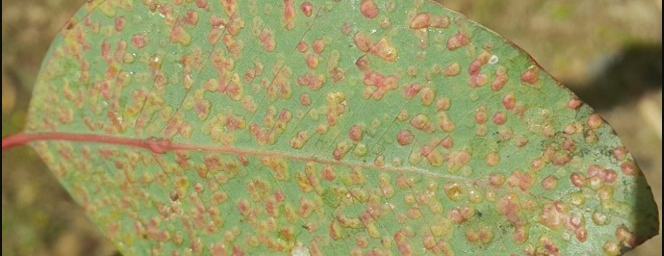
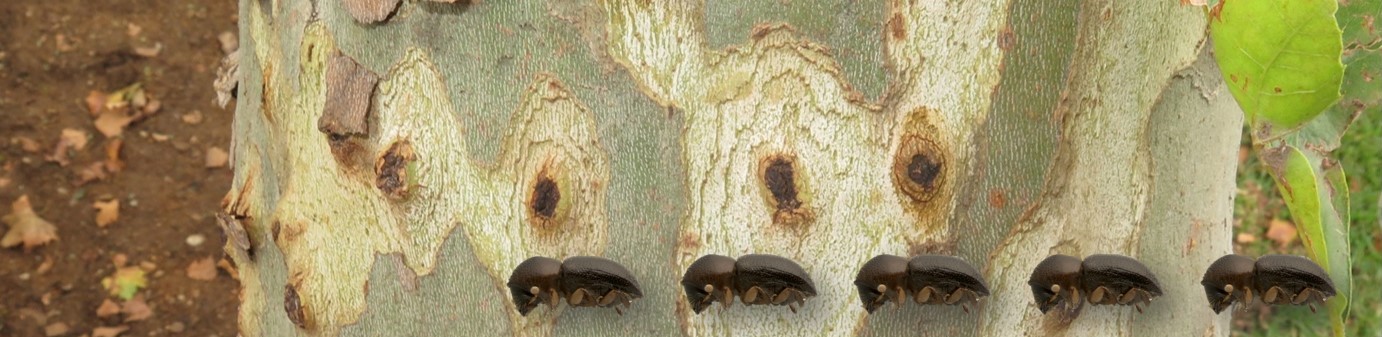
One of the most recent pests of Eucalyptus in South Africa is the bronze bug (Thaumastocoris peregrinus). This insect was first recorded in South Africa in 2003 (and only in 2005 in forestry areas), accidentally introduced from Australia. It is now known to occur in all the major forestry areas of South Africa (Nadel et al., 2009). Heavy infestations are known to cause mass yellowing of the leaves, followed by leaf drop, thus stunting the growth of trees. As with the wattle mirid, the adult is small (2-4 mm) and very active, which can make the insect difficult to see in low infestations. In high infestations, the insects can fall or climb onto people, causing discomfort and even irritation on the skin. The black eggs are laid singly or in clusters. The blue gum psyllid (Ctenarytaina eucalypti) is another sap-sucking insect accidentally introduced from Australia that infests Eucalyptus. However, to date, this insect has not been shown to cause noticeable damage to the trees and is thus not considered a pest.