




Principal investigator: Prof Dave Berger
Collaborator at UP: Dr Sanushka Naidoo
Team members: Liesl van der Linden, Jane Bredenkamp, Degracious Kgoale.
The aim of the project is to understand the molecular mechanisms of plant responses to the bacterial wilt pathogen, Ralstonia solanacearum. This project is based on the model plant, Arabidopsis thaliana (mustard cress), which is known to have a range of "ecotypes" from different parts of the world. These natural variants show phenotypic differences that have a genetic basis. This was exploited in this project, wherein ecotypes were screened for resistance and susceptibility to African isolates of the bacterial pathogen, Ralstonia. Resistant and susceptible ecotypes were identified (Joanne Weich, MSc dissertation, 2004).
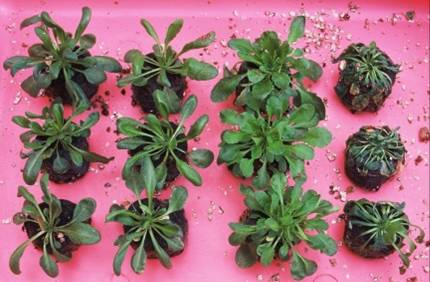
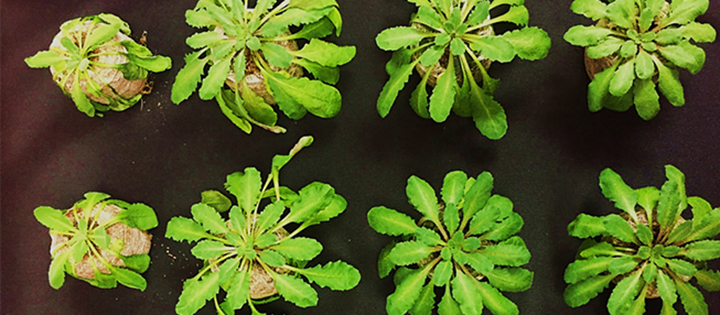
Arabidopsis plants inoculated with Ralstonia solanacearum and controls. L to R: ecotype A (mock-inoculated), ecotype A (no symptoms after inoculation with R. solanacearum), ecotype B (mock-inoculated), ecotype B (highly susceptible (wilted) after inoculation with R. solanacearum).
Detailed genetic, molecular and phenotypic analysis of the pathosystem has revealed an interesting case of gene-for-gene tolerance conferred by an allele of the RRS1 gene in ecotype A, which does not exhibit symptoms but harbours high numbers of the bacterial pathogen (Van der Linden et al, 2013).
Whole genome and custom Arabidopsis microarrays from SSH libraries, constructed at the ACGT Microarray Facility have been used for expression profiling of Arabidopsis plants after infection by the bacterium in a susceptible interaction (Naidoo, et al 2011). Whole genome expression profiling is also underway to explore the tolerant response. This is greatly facilitated by the availability of the Arabidopsis genome sequence and associated bioinformatics resources.
Collaboration:
This research was initiated in collaboration with Dr. Yves Marco (CNRS-INRA, Toulouse, France), and additional collaborators Dr Stephane Genin (CNRS-INRA) and Dr Katherine Denby (University of Warwick, UK) are also involved.
Publications:
-
Van der Linden L, J Bredenkamp, S Naidoo, J Fouché-Weich, KJ Denby, S Genin, Y Marco, DK Berger (2013) Gene-for-gene tolerance to bacterial wilt in Arabidopsis, Molecular Plant-Microbe Interactions, 26, 398-406
-
Naidoo S, Fouché-Weich J, Law P, Denby K, Marco Y & Berger DK (2011) A Eucalyptus bacterial wilt isolate from South Africa is pathogenic on Arabidopsis and manipulates host defenses, Forest Pathology 41(2):101-113
-
Law PJ, Claudel-Renard C, Joubert F, Louw AI, Berger DK (2008) MADIBA: A web server toolkit for biological interpretation of Plasmodium and plant gene clusters, BMC Genomics 9:105
-
Naidoo S, Murray SL, Denby KJ & Berger DK (2007). Microarray Analysis of the Arabidopsis thaliana cir1 (constitutively induced resistance 1) mutant reveals candidate defence response genes against Pseudomonas syringae pv tomato DC3000, South African Journal of Botany 73:412-421.
-
Fouche-Weich J, Poussier S, Trigalet-Demery D, Berger D & Countinho T (2006). Molecular identification of some African strains of Ralstonia solanacearum from Eucalyptus and potato, Journal of General Plant Pathology 72:369-373.
-
Naidoo S, Denby KJ, Berger DK (2005) Microarray experiments: considerations for experimental design, South African Journal of Science, 101:347-354
-
Murray SL, Denby KJ, Berger DK and Loake GJ. (2002). Disease Resistance Signalling in Arabidopsis: Applications for the Study of Plant Pathology in South Africa, South African Journal of Science 98:161-165