


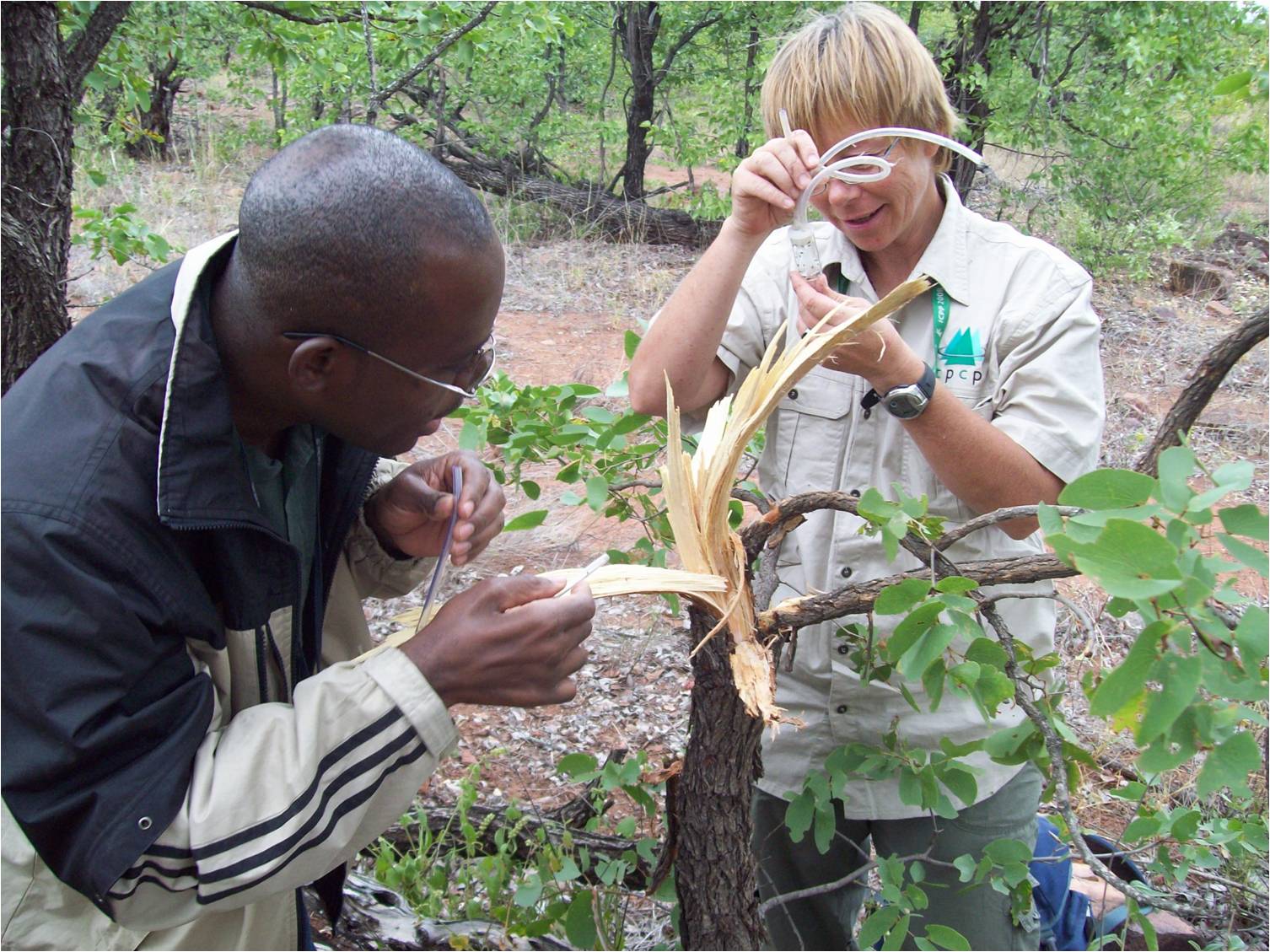
Numerous CPHB projects aim to improve our understanding regarding the biology and ecology of the microbes and insects associated with agricultural plants and native woody hosts in South Africa.

Some of the microbes that are targeted belong to species in the Botryosphaeriaceae, Cryphonectriaceae and Uredinales (Ravenelia, Puccinia and Uromyces), as well as the genera Armillaria, Ganoderma, Fusarium, Mycosphaerella, Phellinus, Ceratocystis, Gondwanamyces, Coniothyrium (Colletogloeopsis / Phaeophleospora / Kirramyces), Cylindrocladium, Dothistroma, Pantoea, Ophiostoma, Candidatus Liberibacter africanus and Phytophthora.

The insects currently receiving most attention include bark beetles, bruchid beetles, as well as Coryphodema tristis and a number of species that could possibly be used in biocontrol programmes.

Various CPHB projects also consider the ecology and population biology of specific tree species to evaluate the effect that human practices (e.g. timber harvesting, coppicing, bark stripping, etc.) might have on the target plant, ecosystems and the conservation of natural habitats. Many further focus on the possible impacts that soil properties, nutrients, rhizobial symbioses and climatic factors might have on the invasiveness of certain species in diverse landscapes. A small number of projects also aim to investigate the effects that drought, frost and fire might have on the sustainable usage of indigenous woody resources.

New Publications

Paap T, White D, Bose T, Burgess TI. (2026) Diversity and phylogeny of Phytophthora Clade 9, including descriptions of three novel species. Mycological Progress 25:29. 10.1007/s11557-026-02140-4
Li GQ, Slippers B, Wingfield MJ, Chen SF. (2026) Diversity, distribution and host range of Botryosphaeriaceae in China. Forest Pathology 10.1111/efp.70077
Joubert M, van den Berg N, Theron J, Swart V. (2026) Leaf bleaching is associated with extensive transcriptional reprogramming in avocado trees with sunblotch disease. Virology 620:110903. 10.1016/j.virol.2026.110903 PDF
Nzuza P, Schroder ML, Slippers B, Maes WH. (2026) Spectral responses to larval and artificial defoliation in Eucalyptus dunnii: Implications for UAV-based detection of Gonipterus damage. Drones 10(4) 10.3390/drones10040250
Six DL, Marincowitz S, Duong TA. (2026) Ophiostoma ipsi-confusi sp. nov. Six, Marinc. & Duong, a consistent symbiotic fungus of the pinyon ips bark beetle, Ips confusus LeConte. Symbiosis 10.1007/s13199-026-01135-9
Yan Z, Zhao Y, Meng X, Gao M, Si H, Zhao G, Bose T, Chang R. (2026) New manganese-oxidizing Acremonium-like fungi from halophytic rhizospheres in the Yellow River Delta, China. Mycologia :1-13. 10.1080/00275514.2026.2627133
Eshetu FB, Barnes I, Nahrung HF, Fitza KNE, Slippers B. (2026) A Century of invasion: How biosecurity influenced populations of Sirex noctilio and Its fungal symbiont in Australasia. Molecular Ecology 35(6):0962 - 1083. 10.1111/mec.70311
Viljoen A, Duong TA, Kanzi AM, Wingfield BD. (2026) Comparative analysis of mitochondrial genomes in the Ceratocystidaceae reveals highly conserved gene organization despite substantial genome size variation. BMC Genomics 10.1186/s12864-026-12755-2
Ribeiro MF, Cavallini G, Solce GN, Favoreto AL, De Souza Passos J-R, Barbosa LR, Hurley BP, Wilcken CF. (2026) Cold storage of Gonipterus platensis (Coleoptera: Curculionidae) eggs for Anaphes nitens (Hymenoptera: Mymaridae) rearing. PeerJ :1-14. 10.7717/peerj.20903 PDF
Pham NQ, Marincowitz S, Marpaung YMAN, Tarigan M, Wingfield BD, Wingfield MJ. (2026) Two Cryphonectriaceae species from Eucalyptus leaves in North Sumatra and their stem inoculation outcomes. Fungal Systematics and Evolution 17:69–79. 10.15761/fuse.2026.17.05 PDF