






FABI News

FABI Events

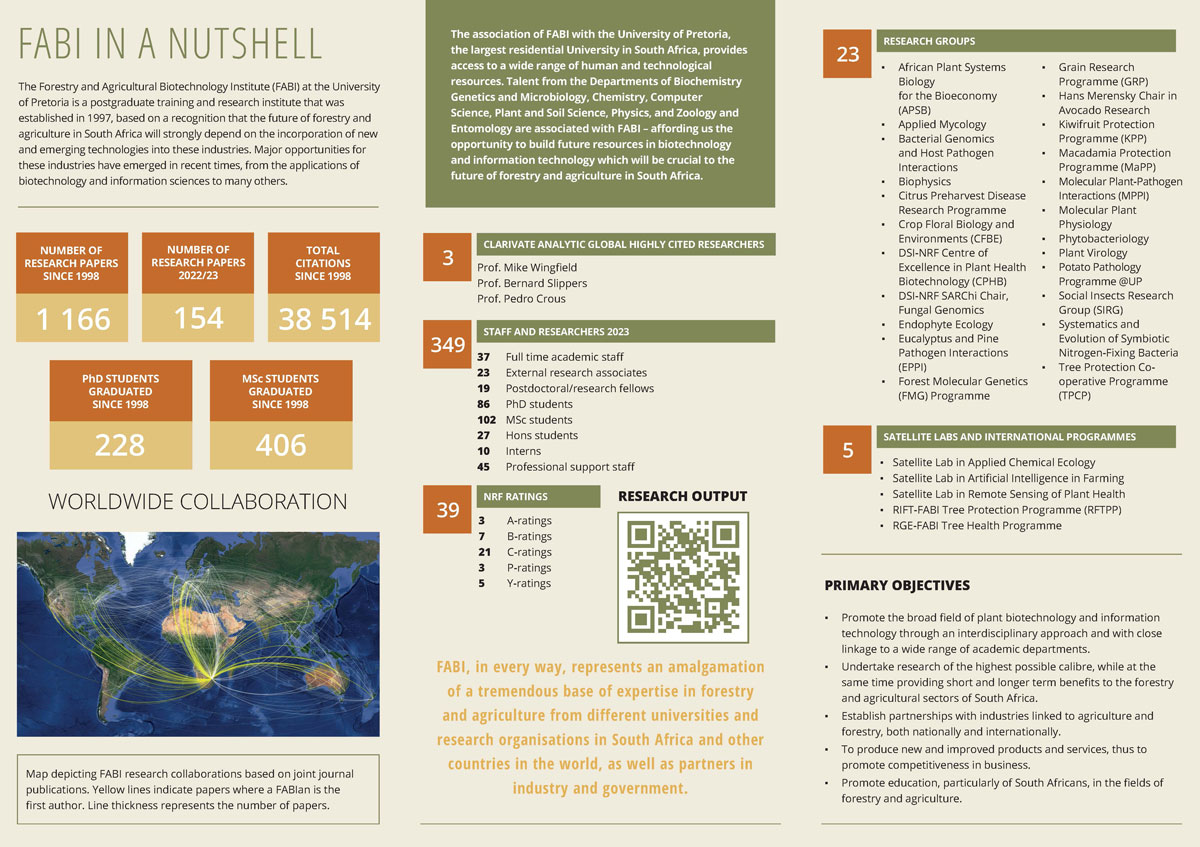
FABI in a nutshell

Research Features

Principal investigator: Prof Dave Berger

Collaborator at UP: Dr Sanushka Naidoo

Team members: Liesl van der Linden, Jane Bredenkamp, Degracious Kgoale.

The aim of the project is to understand the molecular mechanisms of plant responses to the bacterial wilt pathogen, Ralstonia solanacearum. This project is based on the model plant, Arabidopsis thaliana (mustard cress), which is known to have a range of "ecotypes" from different parts of the world. These natural variants show phenotypic differences that have a genetic basis. This was exploited in this project, wherein ecotypes were screened for resistance and susceptibility to African isolates of the bacterial pathogen, Ralstonia. Resistant and susceptible ecotypes were identified (Joanne Weich, MSc dissertation, 2004).
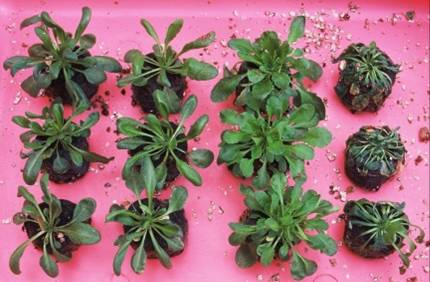
 

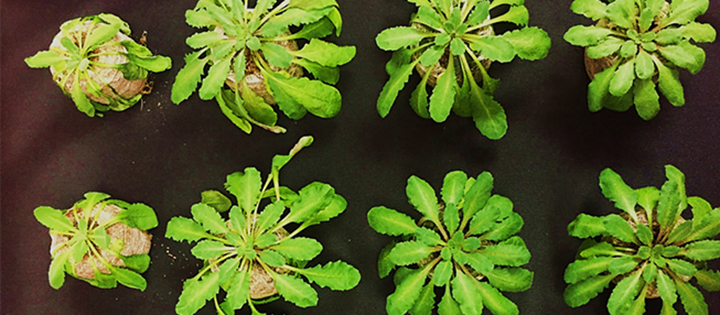
Arabidopsis plants inoculated with Ralstonia solanacearum and controls. L to R: ecotype A (mock-inoculated), ecotype A (no symptoms after inoculation with R. solanacearum), ecotype B (mock-inoculated), ecotype B (highly susceptible (wilted) after inoculation with R. solanacearum).


Detailed genetic, molecular and phenotypic analysis of the pathosystem has revealed an interesting case of gene-for-gene tolerance conferred by an allele of the RRS1 gene in ecotype A, which does not exhibit symptoms but harbours high numbers of the bacterial pathogen (Van der Linden et al, 2013).

Whole genome and custom Arabidopsis microarrays from SSH libraries, constructed at the ACGT Microarray Facility have been used for expression profiling of Arabidopsis plants after infection by the bacterium in a susceptible interaction (Naidoo, et al 2011). Whole genome expression profiling is also underway to explore the tolerant response. This is greatly facilitated by the availability of the Arabidopsis genome sequence and associated bioinformatics resources.


Collaboration:

This research was initiated in collaboration with Dr. Yves Marco (CNRS-INRA, Toulouse, France), and additional collaborators Dr Stephane Genin (CNRS-INRA) and Dr Katherine Denby (University of Warwick, UK) are also involved.


Publications:

  • Van der Linden L, J Bredenkamp, S Naidoo, J Fouché-Weich, KJ Denby, S Genin, Y Marco, DK Berger (2013) Gene-for-gene tolerance to bacterial wilt in Arabidopsis, Molecular Plant-Microbe Interactions, 26, 398-406

  • Naidoo S, Fouché-Weich J, Law P, Denby K, Marco Y & Berger DK (2011) A Eucalyptus bacterial wilt isolate from South Africa is pathogenic on Arabidopsis and manipulates host defenses, Forest Pathology 41(2):101-113

  • Law PJ, Claudel-Renard C, Joubert F, Louw AI, Berger DK (2008) MADIBA: A web server toolkit for biological interpretation of Plasmodium and plant gene clusters, BMC Genomics 9:105

  • Naidoo S, Murray SL, Denby KJ & Berger DK (2007). Microarray Analysis of the Arabidopsis thaliana cir1 (constitutively induced resistance 1) mutant reveals candidate defence response genes against Pseudomonas syringae pv tomato DC3000, South African Journal of Botany 73:412-421.

  • Fouche-Weich J, Poussier S, Trigalet-Demery D, Berger D & Countinho T (2006). Molecular identification of some African strains of Ralstonia solanacearum from Eucalyptus and potato, Journal of General Plant Pathology 72:369-373.

  • Naidoo S, Denby KJ, Berger DK (2005) Microarray experiments: considerations for experimental design, South African Journal of Science, 101:347-354

  • Murray SL, Denby KJ, Berger DK and Loake GJ. (2002). Disease Resistance Signalling in Arabidopsis: Applications for the Study of Plant Pathology in South Africa, South African Journal of Science 98:161-165

New Publications

Nadasen TR, Hein I, Berger DK. (2026) Structural phylogenetics identifies conserved effector families and cell death-inducing proteins from Cercospora zeina. Molecular Plant-Microbe Interactions First Look 10.1094/MPMI-05-26-0048-R
Mbamali SKS, Mohlomi N, Van Der Nest MA, Mchunu NP, Permaul K. (2026) Reciprocal Genome Projection Reveals Reference-Conditioned Functional Variation in Clinical Aspergillus Section Nigri Isolates. Pathogens 10.3390/pathogens15090941
Schertler A, Lenzner B, Dullinger S, Moser D, García-Rodríguez A, Krisai-Greilhuber I, Voglmayr H, Bufford JL, Santini A, Ghelardini L, Capinha C, Reino L, Wingfield MJ, Thines M, Talhinhas P, Dawson W, van Kleunen M, Kreft H, Pergl J, Pyšek P, Weigelt P, Winter M, Essl F. (2026) Are novel and co-xenic associations common in alien fungal and fungus-like plants pathogens?. New Phytologist 10.1111/nph.71455
Thango S, Nsibo DL, Berger DK, Visagie CM, Slippers B. (2026) Phenotypic variation in the in vitro and in planta aggressiveness traits among Exserohilum turcicum strains from South Africa. Plant Pathology 75(4):e70257. 10.1111/ppa.70257
Bradshaw MJ, Paul A, Villani S, Bensch K, Mitchell KJ, Pfister DH, Visagie CM, Garfinkel AR, Quesada-Ocampo L, Aime MC, Braun U. (2026) Modern taxonomy as the foundation for identifying and managing fungal and fungus like plant pathogens. Plant Disease 10.1094/PDIS-12-25-2537-FE
Balocchi F, Wingfield MJ, Paap T. (2026) Occurrence of Phytophthora cinnamomi in the rhizosphere of declining Leucadendron elimense subsp. salteri in South Africa. Forest Pathology 56(4):e70097. 10.1111/efp.70097 PDF
Pham NQ, Wingfield BD, Marincowitz S, Marpaung YMAN, Selebi AP, Tarigan M, Wingfield MJ. (2026) A novel Cryphonectria species (Cryphonectriaceae, Diaporthales) discovered on Eucalyptus, including insights into the mating biology of the genus. Fungal Biology 130:101831. 10.1016/j.funbio.2026.101831
Kim JS, Lee W, Seo CW, Lee JW, Perera RH, Rho SM, Visagie CM, Houbraken J, Lim YW. (2026) A comprehensive assessment of Penicillium diversity in marine environments. Studies in Mycology 115:1–57. 10.3114/sim.2026.115.01
Jami F, Truter M, Pavlic M, Chen SF, Roux J. (2026) Identification of Botryosphaeriaceae species in the South African National Collection of fungi, including a novel species of Oblongocollomyces. African Biodiversity & Conservation 56(1):1-13. PDF
Vettraino AM, Bose T. (2026) Urban green spaces as emerging hotspots for Phytophthora diversity: a global synthesis of host associations, distribution and management gaps. Frontiers in Forests and Global Change 9:1872981. 10.3389/ffgc.2026.1872981
Burgess TI, Wingfield MJ. (2026) Unveiling a hidden menace: Invasive tree pathogens, less known but increasingly threatening Southern hemisphere forests. Annual Review of Phytopathology 64 10.1146/annurev-phyto-011325-100959
Motete T, Solís M, Hammerbacher A, Naidoo S. (2026) Gene expression profiling in Eucalyptus associates Phenylpropanoid resistance to Teratosphaeria destructans. Plant Pathology 10.1111/ppa.70207
Aylward J, Atkins S, Roets F, Danti R, Della Rocca G, Emiliani G, Fraser S, Garbelotto MM, Herron DA, Scali E, Wingfield BD, Wingfield MJ. (2026) High genetic diversity in the Cypress canker pathogen Seiridium cardinale in the Southern Hemisphere. Plant Pathology 75 10.1111/ppa.70212
van Heerden A, Pham NQ, Duong TA, Wingfield MJ, Wingfield BD. (2026) Draft genome sequence of Ganoderma philippii, a serious root rot pathogen of Eucalyptus in Southeast Asia. Australasian Plant Pathology 55:81. 10.1007/s13313-026-01159-1
Schoeman C, Roodt D, Mc Menamin A, Bezuidt O, Dithugoe C, Pinard D, Mizrachi E. (2026) Conserved symbiosis-associated genes in the cycad Encephalartos natalensis suggest co-option for cyanobacterial symbiosis. New Phytologist 10.1111/nph.71311
Townsend G, Hill M, Hurley BP, Roets F. (2026) Native Scolytinae and Platypodinae beetle assemblages in indigenous South African forests and their co-occurrence with the invasive PSHB beetle. Journal of Insect Conservation 30 10.1007/s10841-026-00779-8
Botha I, Maduna SN, Hagen SB, Lall N, Berger DK. (2026) 3RAD-guided SNP discovery for species identification and conservation of the medicinal southern African tree Genus Greyia Hook. & Harv.. Ecology and Evolution 16(5):e73412, 1-29. 10.1002/ece3.73412
Balocchi F, Duncan G, Yilmaz N, Wingfield MJ, Paap T. (2026) The critically endangered geophyte Gladiolus aureus threatened by a wilt disease associated with Fusarium libertatis. Journal of Plant Pathology 10.1007/s42161-026-02227-7 PDF
Bose T, Wingfield MJ. (2026) Plantations are invasive pathogen bridgeheads—response to Li et al.. Trends in Ecology & Evolution 10.1016/j.tree.2026.05.006
Jamieson B-A, Paap T, Pegg GS, Carnegie AJ, Wingfield MJ, Roux J, Hardy GEStJ, Drenth A, Hammerbacher A, Bose T. (2026) Quambalaria spp.: Emerging Tree Pathogens of Concern. Current Forestry Reports 12:13. 10.1007/s40725-026-00274-y