

Phophi Nethononda perseveres to complete her PhD 2026-04-20
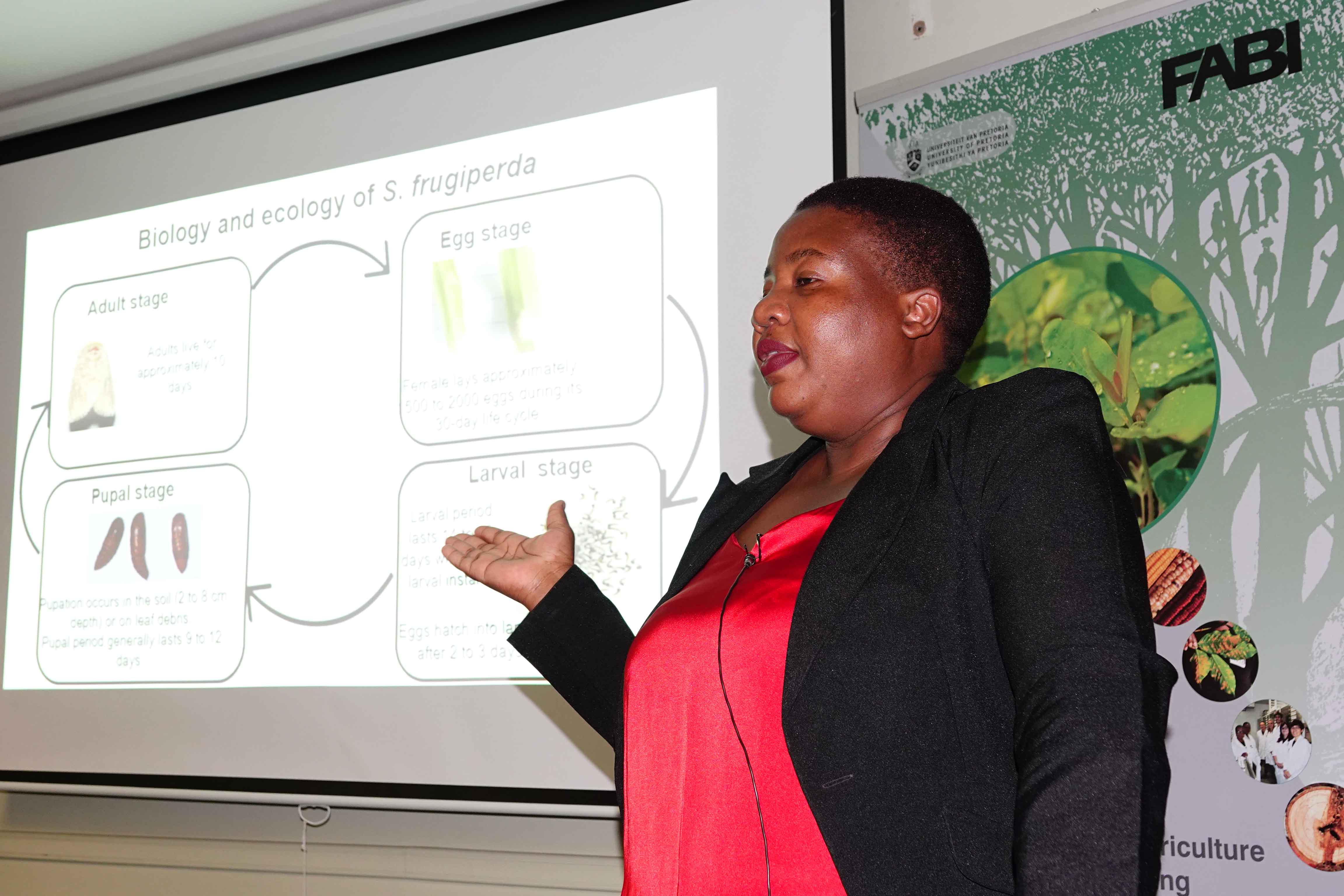
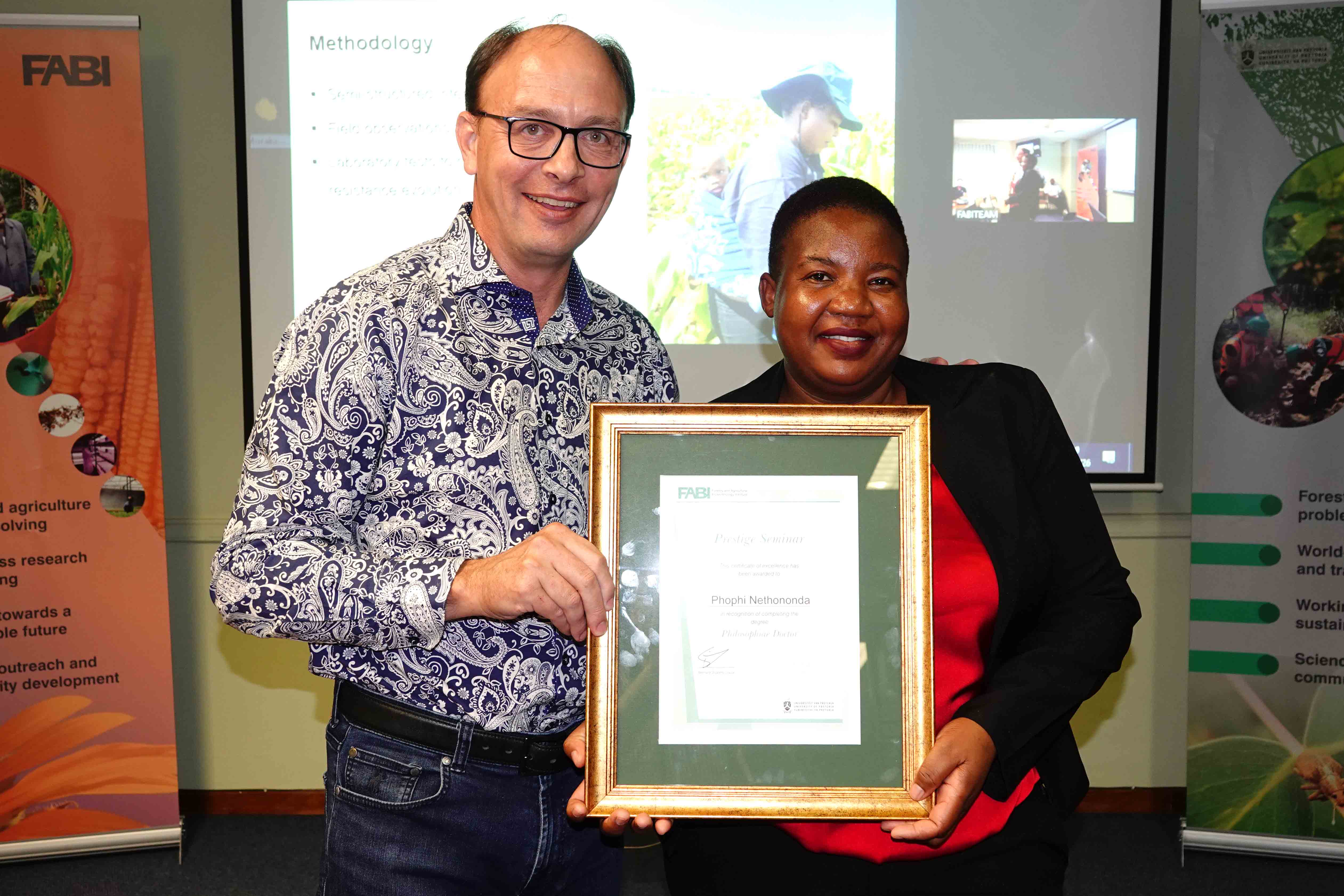
It was a big celebration for Phophi Nethononda on 26 March when she marked the successful completion of her PhD journey in FABI with the presentation of her Prestige Seminar “Management of Spodoptera frugiperdaon Zea mays in irrigation schemes in Limpopo province, South Africa”. This is a very different FABI research project that for the first time includes social science aspects in addition to the usual natural sciences. Phophi completed her PhD under the supervision of Prof. Brett Hurley, Prof. Bernard Slippers, and Dr Moraka Makhura of the University of Pretoria’s Department of Agricultural Economics, Extension and Rural Development. The external examiners for her thesis were Prof. Sidiqat Abdulwahab (University of Ilorin, Nigeria) and Prof. Johnnie van den Berg (North-West University) and Dr Honest Machekano was the internal examiner.
Prof. Brett Hurley congratulated Phophi on persevering to complete her PhD despite numerous challenges and changes along the way. He said that she showed perseverance and was adaptable to change, finding ownership of her project and a passion for interacting with smallholder farmers.
Smallholder farmers play a crucial role in food production; however, their yields are increasingly threatened by insect pests, including invasive species. While IPM is widely promoted as a sustainable approach to pest control, its adoption among smallholder farmers in Sub-Saharan Africa varies significantly. These variations are influenced by factors such as geographical location, levels of awareness, access to essential resources, and the affordability of recommended tools and practices. This study investigated these challenges, focusing on smallholder farming communities in the Dzindi and the Tshiombo irrigation schemes in the Limpopo province, South Africa, where farmers have experienced an invasion of the Fall army worm Spodoptera frugiperda, a highly destructive maize pest.
This was the first study to investigate insect pest challenges and management practices among smallholder farmers in these irrigation schemes in the Limpopo province. The findings emphasize the need for farmer education, sustainable pest control strategies, and enhanced IPM adoption to improve resilience, prevent resistance evolution, and support long-term agricultural sustainability and food security.