

Research Features
Tracing the past, building the future: FABI research unlocks the genetics and genomics of the Sirex woodwasp complex
Tracing the past, building the future: FABI research unlocks the genetics and genomics of the Sirex woodwasp complex
For more than two decades, researchers in the Forestry and Agricultural Biotechnology Institute (FABI) have helped shape global understanding of one of the world’s most important pine pest systems: the Sirex noctilio woodwasp, its fungal symbiont Amylostereum areolatum, and the biological control nematode Deladenus siricidicola. Two new papers led and co-authored from FABI researchers build on that long trajectory of work, from early studies on fungal clonality and compatibility groups, to host specificity, invasion routes, biocontrol performance, and now global-scale population genetics and genomics.
In Molecular Ecology, Firehiwot Eshetu, Irene Barnes, Helen Nahrung, Katrin Fitza and Bernard Slippers present the most detailed historical-genetic analysis yet of the S. noctilio–A. areolatum invasion in Australasia. Using contemporary and museum samples of the woodwasp, together with fungal collections from across the invaded and native range, the study shows that Australian and New Zealand populations have unusually low genetic diversity compared with other invaded regions. It also shows that the fungal symbiont populations in these countries are highly clonal and cluster separately from other countries, while the wasp and fungus show no strong population structure between Australia and New Zealand. Together, these findings suggest early multiple introductions followed by long-term isolation under strong biosecurity regimes, offering a rare century-scale view of how quarantine and management can shape the evolution of an invasive pest complex.
The study also highlights the value of long-term collections and datasets. Historical specimens dating back to 1952, combined with contemporary sampling and global comparative collections, made it possible to reconstruct changes in diversity through time and link invasion history directly to present-day management. Just as importantly, the work connects invasion genetics to biological control, showing why the diversity and compatibility of the wasp, fungus and nematode matter for sustained control success.
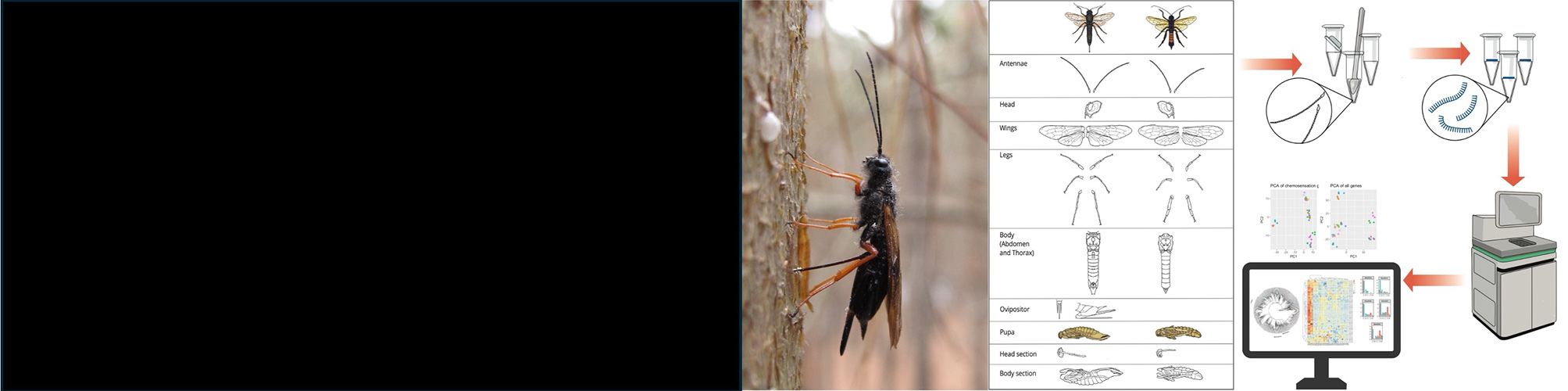
In a second paper, published in Insect Molecular Biology, Alisa Postma, Tuan Duong, Jeremy Allison, Martin Coetzee, Bernard Slippers and colleagues provide a genome assembly for S. noctilio and a major new transcriptomic resource for this pest. The study assembled a 185Mb genome with high completeness, predicted 20,629 genes, generated 15 transcriptomes across developmental stages and tissues, and identified 129 chemosensory genes spanning six major gene families. It also pinpointed candidate genes with tissue- and sex-biased expression that may play important roles in mate finding, host location and oviposition.
Together, these two papers mark an important step forward for research on the Sirex noctilio – Amylostereum areolatum – Deladenus siricidicola system. One provides a global and historical population-genetic perspective on invasion, biosecurity and biocontrol. The other delivers the genomic and transcriptomic toolkit needed to interrogate the molecular basis of chemical ecology and behaviour. For FABI, they reflect both continuity and progress: a research programme that helped define the system historically, and that is now providing the resources to study and manage it at unprecedented resolution.
You can read the papers here: