
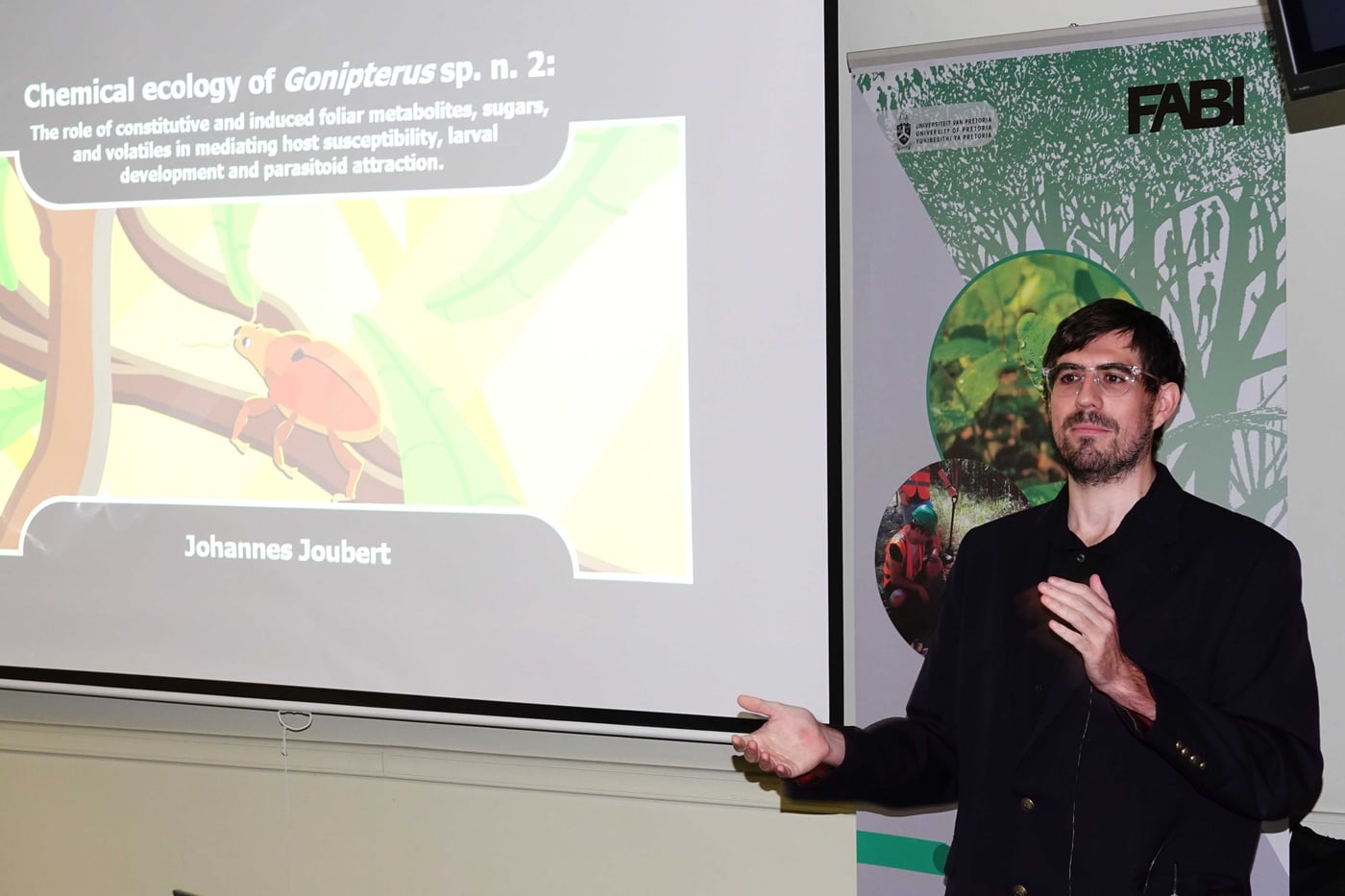
FABI celebrated the successful completion of Johannes Christoff Joubert ’s PhD. He presented his Prestige Seminar “Chemical ecology of Gonipterus sp. n. 2: The role of constitutive and induced foliar metabolites, sugars, and volatiles in mediating host susceptibility, larval development and parasitoid attraction” to a packed FABI Auditorium on 25 March. His PhD was completed under the supervision of Prof. Almuth Hammerbacher , Prof. Brett Hurley , Dr Michelle Schröder and Prof. Jeremy Allison of Natural Resources Canada . The examiners for his thesis were Prof. Meret Huber ( University of Mainz , Germany) and Prof. Andrés Gonzalez ( Universidad de la República , Uruguay) and the internal examiner was Prof. Chris Weldon of the Department of Zoology and Entomology . Prof. Almuth Hammerbacher lauded Christoff for being a big contributor to the FABI community efforts, but who also does excellent research. She described him as a serendipitous gain for FABI and her research group as he has a natural talent for engineering but applied to natural sciences; his research is at the cutting edge of science, and he currently maintains scientific equipment worth over R30 million. She concluded by saying that he does everything with a smile. Christoff completed both his MSc and PhD degrees in FABI and has won numerous FABI awards including FABIan of the Year (2023), Mentorship Awards, Getting the Message to the Public Award, and Creative Arts Award. He is also known for his excellent presentation skills and he was a finalist in the FameLab SA contest and a winner in the IUFRO WP 7.03.16 webinar series - Africa session. Eucalyptus is one of the most widely planted hardwood genera globally, valued for its rapid growth, wood quality, and adaptability to diverse environments, serving as a primary source of fibre for pulp, paper, and refined derivatives. However, Eucalyptus is vulnerable to an ever-increasing list of pests and pathogens including the defoliating weevil Gonipterus sp. n. 2, which causes severe growth suppression and economic damage in its invasive range. Christoff’s study aimed to understand the biochemical, molecular, and ecological factors governing the tripartite interaction between the tree, the herbivore, and its classical biocontrol agent, the egg parasitoid Anaphes nitens , is essential for developing sustainable management strategies. The findings from this important and groundbreaking study reveal a critical trade-off: traits selected for plantation productivity may undermine biotic resistance. It establishes a foundation for breeding resistant trees by identifying key metabolites that influence herbivore performance, parasitoid recruitment, and host suitability.